Coro is a modular cybersecurity platform for small and mid-sized businesses. It is run out of Chicago, with offices in New York, Tel Aviv, and Europe. One of my biggest passions has always been crafting and streamlining. I’ve had the privilege of building strategies across multiple organizations, ensuring alignment, engagement.
The challenge: no shared knowledge
Nothing was written down anywhere in a way that could be shared internally. Already close to 200 employees globally, and the knowledge was basically stuck in the CTOs head - and maybe a couple of other folks too.
- Enablement was not technical and didn't understand the product. They couldn't create materials at all to support the company efforts without relying on shared internal knowledge, which was entirely absent.
- Sales could not find the content they needed for a customer conversation. Tool sprawl was severe, and HR was separately evaluating Notion and a couple of other options, which would have made it worse.
- Marketing was writing only SEO-keyword posts and the landing pages left somethng to be desired too.
And no team really knew what other teams were doing at all.
I had been hired to build a team covering two functions that I needed to build from scratch: product marketing and technical writing.
The solution: one platform, all teams
Working with the CFO, I lead the selection of a shared knowledge platform that would serve Sales, and also the rest of the teams as well.
Why: the ethos and approach
Alignment and inclusion are critical pillars to a successful GTM plan for any business. At the time, we had a huge tool sprawl issue with different teams using multiple free tools to document their internal shared knowledge with each other. To avoid institutionalizing this sprawl and support better knowledge sharing, I built a team for tool selection that included leaders representing the entire business and ultimately, I chose a knowledge-sharing platform over traditional GTM tools to support knowledge-sharing overall, alongside HR enablement as well as sales.
Internal platforms, when used strategically, do more than just inform—they empower teams, streamline workflows, and break down silos, all of which directly impact the bottom line.
The process is written up here as seven steps for choosing the right software for your team, drawn directly from this project. I was arguing the ROI case for internal platforms publicly at the same time, because the hardest part of this is usually getting a company to fund it before it is big enough to feel the pain.
We chose Axero, a decision I made jointly with the VP of Operations. I ran the negotiation, and I took the budget request to the CFO myself, in a one to one conversation.
How we drove adoption
Every team elected a knowledge owner, nominated by their own manager and accountable for what their team knew. The sales owner and I worked closest of all because my focus was primarily revenue. At the same time though, I also provided ongoing support for HR to onboard, and when it came time, I also worked very closely with Marketing for the same purpose.
We wired the platform into SharePoint, Google Drive and Slack, then built a question and answer bot in Slack on top of it (this was before a general purpose model could do that kind of retrieval). When I showed the bot to the VP of Channel in August 2024, he said it was the best news he had had all year.
Surprisingly, the whole engineering and product organization moved onto the platform as well, rather than staying in Confluence as a uniform decision to respect and set an example for adopting this platform.
The results
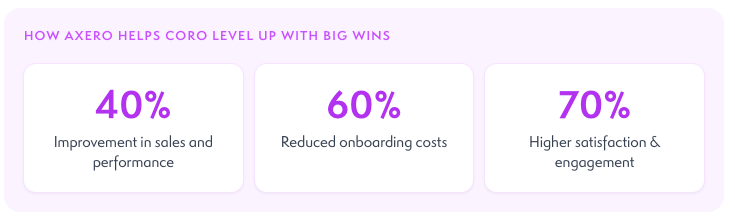
Axero's published case study on the rollout reports a 40% improvement in sales performance, a 60% reduction in onboarding costs and a 70% rise in satisfaction and engagement.
After I left Coro, a new channel hire wrote up her first week publicly: systems ready on day one, product information and value proposition she could find, and a clear picture of who the company sold to. She reached all of it by her third day without knowing who to ask.