
Your first marketing hire should be a product marketer at the core. The reason is in the questions every marketing strategy has to answer, and in the order you answer them.
Most startups hire a product marketer too late. By then there's a sales deck iterated thirty times, a website written by the CTO, and a pipeline full of leads who were never quite the right fit. The next marketer's first job is archaeology.
What does a marketing strategy need answered first?
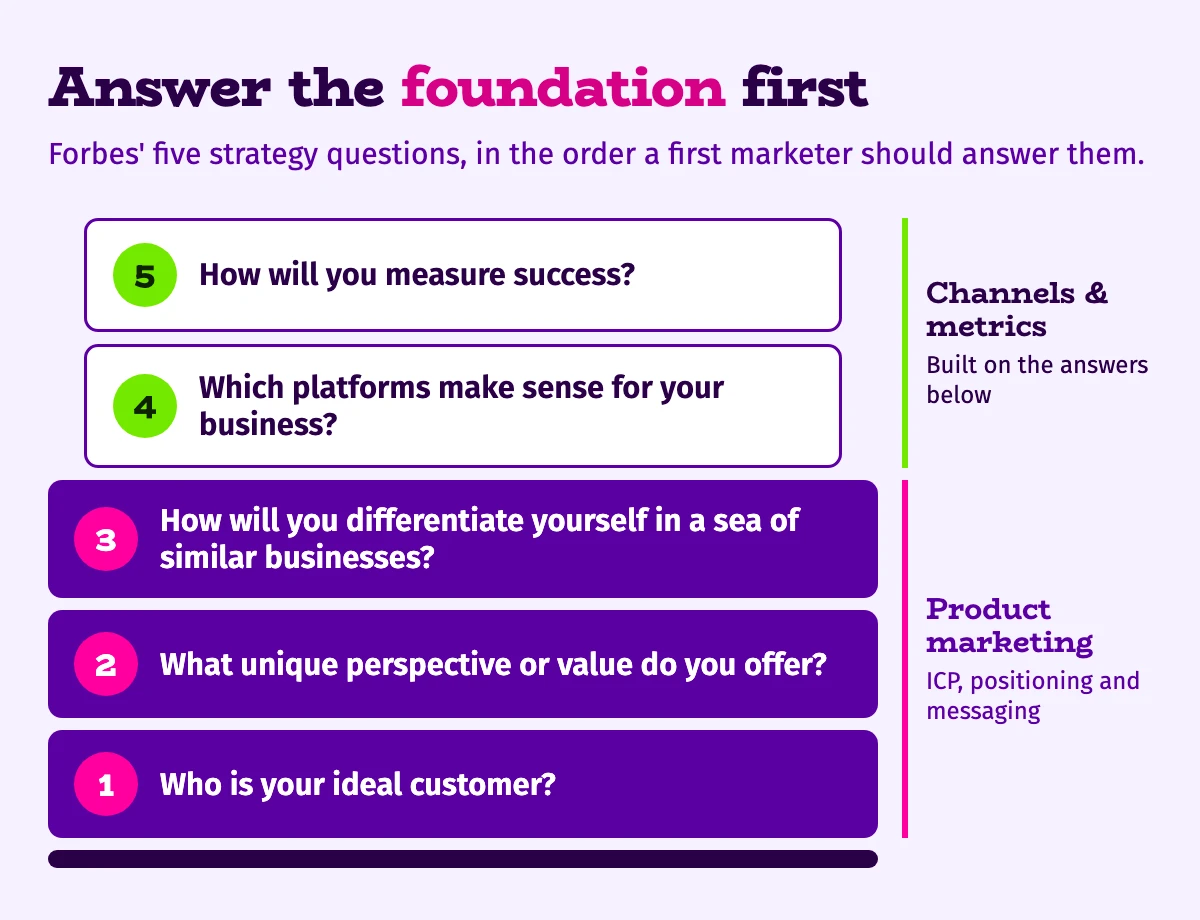
Leeron Hoory's digital marketing strategy guide for Forbes Advisor puts it plainly: "A strong digital marketing strategy answers key questions:"
- Who is your ideal customer?
- What unique perspective or value do you offer?
- Which platforms make sense for your business?
- How will you measure success?
- How will you differentiate yourself in a sea of similar businesses?
Read that list as a job description. Three of the five questions are positioning questions: the customer, the value and the difference. A product marketer answers them for a living. The other two, platforms and measurement, depend on the first three. You can't pick a platform before you know who you're trying to reach there, and you can't define success before you know what you promised.
Here's how each question maps to the work.
| Forbes question | What answers it | What a PMM-first hire delivers |
|---|---|---|
| Who is your ideal customer? | Customer discovery | A written ICP with firmographics, behavioral signals and buying context |
| What unique perspective or value do you offer? | Positioning | A value proposition in the customer's own language |
| How will you differentiate yourself? | Competitive positioning | A messaging framework that product, marketing and sales all use |
| Which platforms make sense? | Channel strategy | Channels chosen by where the ICP researches and buys |
| How will you measure success? | Goals and metrics | Targets tied to business goals, with win/loss evidence behind them |
Why does a channel-first hire start in the wrong place?
A channel specialist starts at question three. That's the job they were hired to do, and they'll do it well. The trouble is what sits underneath. A founding product marketer builds the foundation. A channel hire decorates a house that nobody has poured a foundation for, and every coat of paint has to come off when the foundation finally goes in.
Positioning problems are also slow to show up. Nobody sees them in the first quarter. By the time the symptoms appear, you've already paid for them:
- Sales cycles stretch, because reps tell different stories and buyers can't find the throughline.
- Prospects churn early, because the product didn't match the promise they heard.
- Demand gen spend goes to the wrong segment.
- New marketers join a void and nothing they produce converts.
All four trace back to the same root: nobody did the positioning work early enough. It felt premature. There was product to ship, investors to update and engineers to hire. The messaging could wait. It couldn't.
How do you know you need that hire now?
You probably need a product marketer at the core of your first marketing hire if any of these sound familiar:
- Engineers describe the product differently. If the people who built it can't agree on what it is, nobody else will.
- Sales promises what the product can't deliver. There's no shared source of truth for what the product does and for whom.
- You don't have a written ICP. A document with firmographics, behavioral signals and buying context, not a slide. Without it, every opportunity is a guess.
- Your website and your demo tell different stories. Buyers notice. They just don't tell you why they went quiet.
What order should the work go in?
The order is the method. Research comes before copy, and positioning comes before channels.
- Learn the customer's language. How do they describe the problem, what have they tried, and where did the existing options fall short?
- Write the ICP. Put the firmographics, the signals and the buying context in one document.
- Write the positioning. State the value and the difference before the sales team improvises its own version.
- Build the messaging framework. Give product, marketing and sales one narrative to pull from.
- Choose the channels. Pick the platforms where that ICP already looks for answers.
- Set the measures. Tie every target to a business goal.
Skipping the first four doesn't save time. It moves the cost to month six, when the messaging everybody signed off on turns out to describe a buyer who doesn't exist.
Acting on the answers matters as much as finding them, including when the answer is inconvenient. At Visual Layer, a computer vision company, we had a product-led growth motion underway. After a product-market-fit analysis with the founders, I cancelled it and moved us to account-based marketing and direct enterprise sales. ARR went from under $1M to $3M, and Camtek acquired the company in April 2026. Optimizing that funnel was the channel-first move. The positioning work showed it was the wrong funnel.
Does a product marketer know enough about channels?
Some don't, and that's the fair objection. A first marketer can't be a strategist who hands everything off, because at a startup there's nobody to hand it to. Hire for product marketing at the core and check for range around it. Three interview questions test both at once:
- Who do you think our ideal customer is, and how would you confirm it?
- Which two channels would you start with for that customer, and why those two?
- What would you measure in your first 90 days, and what number would tell you it's working?
Listen for where each answer begins. A strong candidate starts every answer with the customer and ends it with a number. If the first answer names a platform before it names a buyer, you're interviewing a channel specialist.
The order also has to outlast the first hire. At Coro, I organized every release around the same sequence: market understanding, then messaging and positioning, then execution and measurement. The GTM framework work case shows how that works once there's a team to run it.
Key takeaways
- Three of Forbes' five strategy questions are positioning questions.
- Platforms and measurement depend on the answers to those three.
- A channel-first hire starts at question three and builds on a guess.
- A PMM-first hire starts with research, then writes the ICP, positioning and messaging.
- Hire for product marketing at the core, and check for channel range around it.
If you're about to hire your first marketer, or you've hired one and the story still changes from rep to rep, bring your current deck to a free 30-minute call. We'll run it against the five questions, and you'll leave knowing which ones your company can't answer yet.